
The Importance of Play Activities for Cognitive Growth in a Nursery in UAE
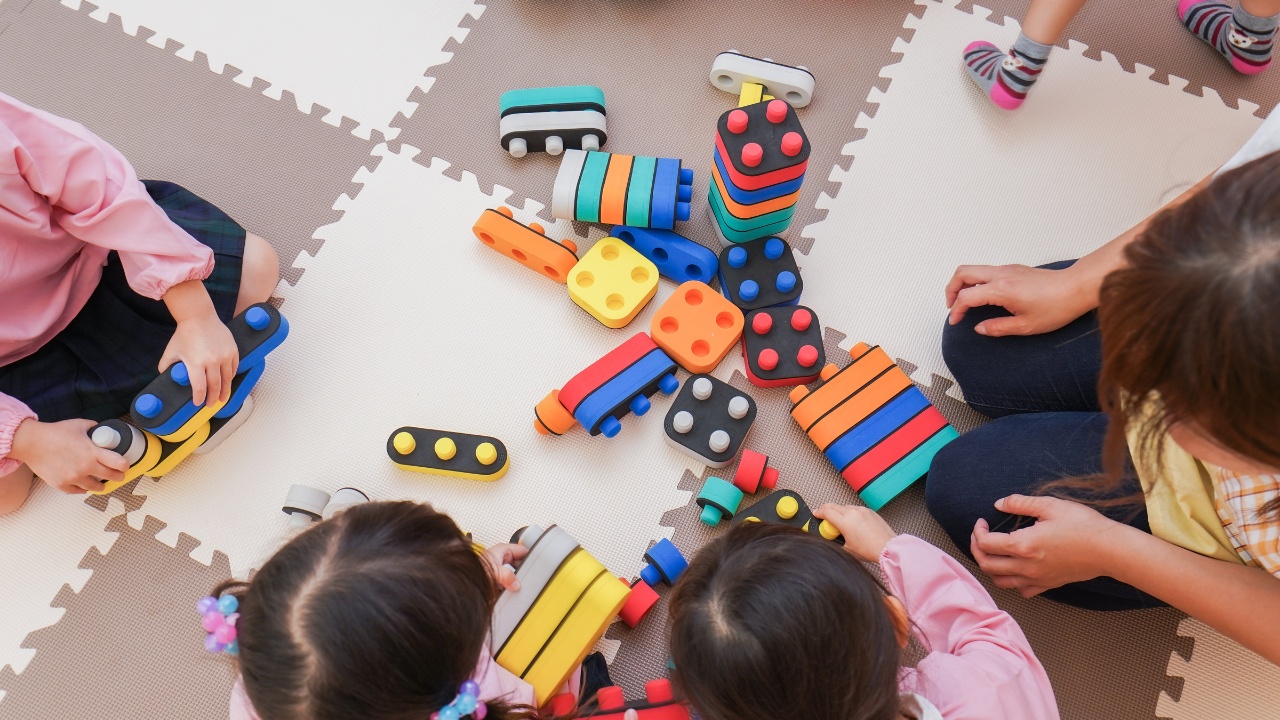
There’s a moment that many parents quietly worry about — watching their child spend an entire morning building a tower of blocks, knocking it down, and building it again. Is this learning? Is this enough? For any family who has walked through the doors of a quality nursery in UAE, the answer from every educator is the same: not only is it enough, it might be the most important thing their child does all day.
Play is not the opposite of learning. For young children, play is learning — and the science behind that truth is both fascinating and deeply reassuring.
The Hidden Work Happening During Play
When a three-year-old child crouches over a sandpit, pouring water into it with great care and interest in observing changes in texture, she is conducting a scientific experiment. When two young children are negotiating and agreeing on the rules of play in a pretend shop, they are engaging in language, social, and mathematical skills simultaneously. When a young boy is building a bridge using wooden planks and testing whether it can carry the weight of a toy car, he is developing engineering skills which are essential to physics concepts years ahead.
This is the beauty of play-based learning. It is not obvious from outside. There are no textbooks, no repetition, and no rows of students. But inside this play and apparent chaos, there is intense activity in the brain.
Research into early childhood development has found that “play, especially open-ended play, activates the prefrontal cortex, which is the part of the brain used for decision-making, problem-solving, and regulating emotions.” Children who are provided with a rich play experience in their early years of development have been found to possess stronger executive function skills, memory retention, and flexibility of thought than those who are provided with a more passive style of learning in their early years of education.
What Play-Based Learning Looks Like in Practice
In a well-designed environment, play is never accidental. The environment, in fact, becomes the curriculum. For example, the educator might set up learning areas with deliberate intention: a role-playing area with props for storytelling, a building area for the development of spatial understanding, and a sensory table for the development of children’s vocabularies and fine motor skills.
The role of the educator in play learning is subtle, yet critical. Instead of controlling the play, the educator’s role in play learning is to observe, listen, and wait for opportunities to add depth and breadth to the child’s play. For instance, the educator might ask, “What do you think will happen if you add one more block?” and suddenly transform play with building blocks into an exercise in cause and effect.
Another area that requires special attention is outdoor play. In the UAE, outdoor spaces are designed in such a manner that children are provided with the opportunity to develop their gross motor skills, take risks, and connect with nature. Running, climbing, digging, and balancing are all important for physical development, but they also help children develop confidence and spatial awareness, which cannot be achieved through indoor activities.
Play with other children has its own set of cognitive gifts. Learning to share, taking turns, tolerating frustration, and negotiating conflicts are not peripheral to the educational process. These are the building blocks of emotional intelligence, and they are learned through thousands of small social interactions that occur naturally through play.
Choosing a Setting That Takes Play Seriously
Not all early years settings take the business of play as seriously as they should. Some still view it as a reward for ‘real’ work, or as time between other activities. Parents, when visiting nurseries, should ask about the place of play in the daily routine, how play is viewed by the educators, and how the physical environment is designed to encourage playfulness.
The answers to these questions will tell you a great deal about the depth of their understanding of early years development.
For families across the region, choosing the right nursery in UAE means choosing a place that understands a fundamental truth: a child absorbed in play is not wasting time. They are doing the most serious, the most joyful, and the most lasting work of their young lives, building the mind they will carry with them into everything that comes next.